

If you want your timepieces to run smoothly, choosing the right watch battery tester is key. The Quartz Watch Battery Tester Tool is perfect for various battery types and alerts you when power’s low. The Watch Button Cell Tester is compact for easy handling. For versatility, consider the DLYPOW or Dlyfull LCD testers. Each tester has unique features to guarantee you’re always in tune with your watch’s energy needs. Stick around to discover which options fit your lifestyle best!
DLYPOW Universal Battery Tester for Household Batteries
Product not found or API error.
If you’re tired of rummaging through a drawer full of batteries, the DLYPOW Universal Battery Tester is your solution. This compact device checks AAA, AA, C, D, 9V, 1.5V, and button cell batteries with ease. Just place the battery in the designated slot, and you’ll get a quick status read—green for good, yellow for low, and red for replace. Its magnetic design keeps batteries secure during testing, and it doesn’t need an external power source. Lightweight and portable, it’s perfect for testing batteries in gadgets like remotes and flashlights, helping you clear out that clutter efficiently.
Best For: Those seeking an easy and efficient way to check the status of various household batteries without the need for an external power source.
Pros:
- Compact and lightweight design enhances portability and ease of storage.
- Color-coded indicators provide quick and clear battery status readings.
- Magnetic features secure batteries during testing, preventing any shifting or dropping.
Cons:
- Does not provide detailed voltage readings for batteries.
- Limited to basic battery status checks, may not satisfy advanced users.
- May require multiple tests for different battery types due to design limitations.
Dlyfull LCD Display Universal Battery Tester
Product not found or API error.
The Dlyfull LCD Display Universal Battery Tester stands out for its impressive compatibility, making it the perfect choice for anyone juggling multiple battery-operated devices. You can easily test AA, AAA, C, D, 9V, and various button cell batteries, ensuring you know which ones are functional. The crisp LCD screen provides immediate results, showing battery health as poor, weak, or good. Plus, it’s compact and lightweight, perfect for portability. Users love how it quickly identifies weak batteries, saving money by prolonging their lifespan. With high satisfaction ratings, this tester is a valuable tool for both casual users and professionals alike.
Best For: The Dlyfull LCD Display Universal Battery Tester is best for users with multiple battery-operated devices, including casual consumers and professionals like electrical engineers.
Pros:
- Wide Compatibility: Tests a variety of battery types including AA, AAA, C, D, 9V, and various button cells.
- Immediate Results: Crisp LCD display provides quick and clear battery health status.
- Cost-Effective: Helps identify weak batteries, prolonging their lifespan and reducing unnecessary replacements.
Cons:
- Not for Rechargeables: Does not test rechargeable batteries or provide results for them.
- Limited to Non-Rechargeables: Cannot be used for testing rechargeable batteries, limiting its overall utility.
- False Positives Claims: Despite user satisfaction, there are claims of false positives in testing that some may find concerning.
La Crosse 911-65557-INT Portable Digital Battery Tester,Black

For those who frequently manage a variety of batteries, the La Crosse 911-65557-INT Portable Digital Battery Tester stands out as an essential tool. This compact tester checks rechargeable and alkaline batteries, including AAA, AA, C, D, N, 9V, and lithium button cells. Its simple three-step operation allows you to select the voltage range, insert the battery, and slide the tray closed. Weighing just 1.13 ounces, it easily fits in your purse or backpack. With a digital display that shows voltage and strength levels, you’ll quickly know whether your batteries are good to go or need replacing.
Best For: Individuals who frequently manage a variety of batteries and need a portable solution for testing battery strength and voltage.
Pros:
- Compact and portable design makes it easy to carry in bags or purses.
- User-friendly operation with a simple three-step process for quick testing.
- Digital display provides clear and accurate readings of battery voltage and strength.
Cons:
- Limited to testing specific battery sizes; may not accommodate all battery types.
- Requires battery power to operate, which may need replacement over time.
- Some users may prefer analog testers for their simplicity and lack of electronic components.
Gardner Bender GBT-500A Battery Tester
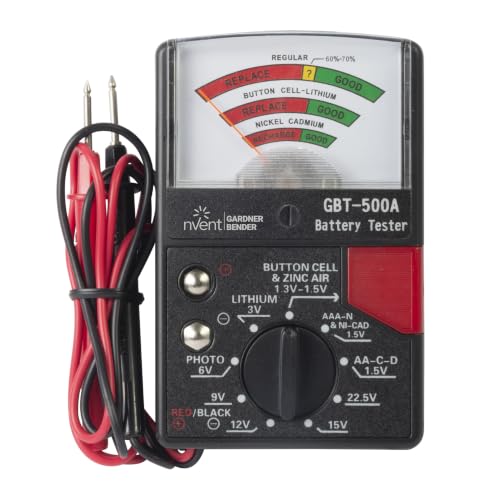
Designed with versatility in mind, the Gardner Bender GBT-500A Battery Tester is an excellent choice for anyone needing to test a wide range of battery types, from 1.5 V button cells to 22.5 V photo cells. Weighing just 0.22 lbs, this compact tester features an analog readout and test leads for easy operation. It reliably determines if your batteries are charged or need replacement, making it perfect for alkaline and rechargeable batteries. Users appreciate its straightforward design and kickstand for easy viewing. With a solid 4.6-star rating, it’s a trusted tool for keeping your timepieces and devices running smoothly.
Best For: The Gardner Bender GBT-500A Battery Tester is best for home users and hobbyists who need a reliable tool for testing a variety of battery types, from small button cells to larger photo cells.
Pros:
- Easy to use with a straightforward design and kickstand for better visibility.
- Versatile, capable of testing both alkaline and rechargeable batteries across a wide voltage range.
- Highly rated by users for reliability and long-lasting performance.
Cons:
- Some users report that the accuracy of readings can be inconsistent.
- Requires careful interpretation of analog readings for accurate results.
- May not be as robust as digital alternatives for some users’ preferences.
Quartz Watch Battery Tester Tool
Product not found or API error.
A Quartz Watch Battery Tester Tool is an essential gadget for anyone keen on maintaining their timepieces and small electronics. This portable device tests 1.5V and 3V button cell batteries, including lithium, silver oxide, mercury, and alkaline types. You’ll appreciate its ability to detect low battery levels with sound and light alerts, helping you decide if your quartz watch needs a new battery or repairs before you open the case. Users rave about its reliability and ease of use, making it a cost-effective alternative to pricier options. It’s perfect for jewelry businesses, car remotes, and key fobs too!
Best For: The Quartz Watch Battery Tester Tool is best for watch enthusiasts, jewelry businesses, and anyone needing to check the battery status of small electronics easily and efficiently.
Pros:
- Multi-functional: Tests various types of button cell batteries, providing versatility.
- Portable: Compact design allows for easy transport and use anywhere.
- Cost-effective: Offers high functionality at a fraction of the price of similar products.
Cons:
- Limited to button cells: Not suitable for testing larger batteries used in other devices.
- May require batteries: Some units may need batteries to operate, adding extra cost.
- Sound alerts may be bothersome: The audible alert might be inconvenient in quiet settings.
Watch button cell Tester Watch battery Checker
Product not found or API error.
The OTOOLWORLD Watch Button Cell Tester stands out as an excellent choice for watch enthusiasts and repair professionals who need a reliable way to check battery functionality. Compact and lightweight, it measures just 4.65 x 2.68 x 1.26 inches and weighs only 0.02 pounds. You can easily test various battery sizes, including 7mm, 10mm, and 20mm. Powered by batteries, this handy tool operates as an ohmmeter, providing accurate readings. While some users appreciate its functionality, a few mention difficulties in holding smaller batteries or occasional malfunctions. Overall, it’s a solid addition to your watch repair toolkit.
Best For: Watch enthusiasts and repair professionals seeking a reliable tool for checking battery functionality.
Pros:
- Compact and lightweight design makes it easy to handle.
- Compatible with various battery sizes (7mm, 10mm, and 20mm).
- Operates as an ohmmeter for accurate battery readings.
Cons:
- Some users report difficulties in holding smaller batteries securely.
- Occasional malfunctions have been noted in certain units.
- Batteries are not included, requiring separate purchase.
2 Pack Universal Battery Tester for AA/AAA/C/D/9V/Button Cell Batteries
Product not found or API error.
If you need a quick and efficient way to check the status of various household batteries, the 2 Pack Universal Battery Tester is an excellent choice. This lightweight and portable tester evaluates AA, AAA, C, D, 9V, and button cell batteries, making it versatile for your needs. With a simple calibrated scale—green for good, yellow for low, and red for replace—it’s easy to use. Just insert the battery with the positive terminal facing the red slide. While it’s affordable and convenient, some users note accuracy issues, so it’s best for casual checks rather than critical testing.
Best For: Casual users looking for an affordable and convenient solution to quickly assess the status of various household batteries.
Pros:
- Affordable: Priced at $5 for two testers, providing great value for quick assessments.
- Easy to Use: Simple calibrated scale makes it clear to understand battery status at a glance.
- Versatile: Can test a wide range of battery types including AA, AAA, C, D, 9V, and button cells.
Cons:
- Accuracy Issues: Some users report discrepancies in readings, with certain batteries not registering correctly.
- Durability Concerns: Lightweight design may feel less sturdy, and the slider mechanism could wear out with frequent use.
- Not for Critical Testing: May not be reliable enough for more serious or critical battery testing needs.
Factors to Consider When Choosing Watch Battery Testers
When picking a watch battery tester, you need to evaluate several key factors. Think about battery compatibility, testing accuracy, and how easy it is to use. Also, don’t forget to weigh portability and price to get the best value for your needs.
Battery Compatibility Options
Choosing a watch battery tester involves considering several key compatibility options to guarantee it meets your needs. You’ll want a tester that can handle multiple types of button cell batteries, including lithium, silver oxide, mercury, and alkaline configurations. It’s also essential to look for testers that specify compatibility with various watch battery sizes, such as 1.5V and 3V, to accommodate different models. Testers offering audible or visual alerts for low battery levels can help you quickly identify when a replacement is necessary. Additionally, opt for testers that check batteries without needing to open the watch, saving you time and reducing the risk of damage. Finally, choose a lightweight and portable tester for easy use, especially if you often check batteries for watches and small electronics.
Testing Methodology and Accuracy
Battery compatibility options lay the groundwork for selecting a watch battery tester, but the testing methodology and accuracy play an essential role in ensuring you get reliable results. Look for testers that utilize sound and light alerts or visual indicators for low battery levels. Accuracy is key; make sure the tester reliably reads lithium and alkaline button cells to avoid false positives. Versatility matters too, so choose a tester that can handle various battery types like lithium, silver oxide, and alkaline. Some testers even apply a load during testing, offering a more realistic assessment of battery strength under typical usage. Finally, opt for a user-friendly design to streamline your battery management tasks.
Portability and Design Features
While you’re evaluating watch battery testers, portability and design features are essential for guaranteeing ease of use and convenience. Look for compact and lightweight testers that fit easily in your purse or tool kit, allowing for quick battery checks on the go. Designs with non-slip grips or ergonomic shapes enhance comfort during testing. Choose testers with clear, easy-to-read displays like LCD screens or color-coded indicators for a quick assessment of battery status. Opt for models that streamline operation, requiring minimal steps to insert batteries and get results. Finally, evaluate the tester’s durability and build quality to make certain it withstands regular use without compromising performance or accuracy. These factors will help you make a smart choice for your watch maintenance needs.
Ease of Use
How do you guarantee a hassle-free experience when testing watch batteries? Start by choosing testers that offer simple operation, allowing you to quickly insert the battery and get results without complicated setups. Look for devices with clear visual or audible indicators, like color-coded lights or sound alerts, to enhance your testing experience. Lightweight and portable models are ideal, making it easy to carry them for on-the-go testing of various batteries. Select testers that don’t need an additional power source, using the battery being tested for operation. Finally, opt for models that can handle multiple battery sizes and types, giving you versatility without the need for multiple devices. This way, you’ll assure easy and efficient battery testing.
Price and Value Considerations
Choosing a watch battery tester involves more than just picking the cheapest option; you need to evaluate the balance between price and functionality. Prices can range from about $5 for basic models to over $100 for advanced testers. Consider what features you need: some testers offer simple checks, while others have digital displays and can test multiple battery types. Investing a little more in a durable, reliable model can save you money by reducing replacements. Check the warranty or return policy, as a good warranty enhances value by covering defects. Finally, think about how often you’ll use it; if you’re a casual user, a budget option may suffice, while professionals might want a higher-end model for accuracy.


